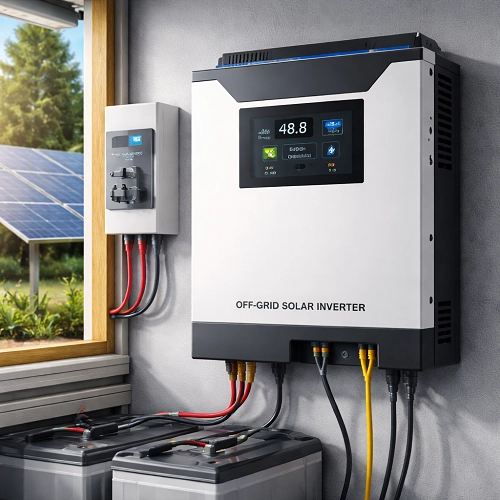
Solar power systems are growing rapidly around the world as alternatives to traditional energy sources, especially in remote areas or where grid electricity is unreliable or unavailable. A core component of these systems is the off-grid solar inverter—a device that makes solar energy usable for everyday electrical loads.
What Is an Off-Grid Solar Inverter?
An off-grid solar inverter is an electronic device that:
- Converts DC (Direct Current) power from solar panels and batteries into AC (Alternating Current) power used by standard household appliances, and
- Manages energy flows between panels, batteries, and loads in systems not connected to a utility grid.
Unlike grid-tie inverters, which feed power into the grid and require a grid reference for synchronization, off-grid inverters operate independently and must regulate all power production and use within the system.
Key Functions of an Off-Grid Inverter
- DC → AC Conversion: Converts battery/DC bus voltage (e.g., 12 V, 24 V, 48 V) to standardized AC outputs (commonly 120 V, 230 V at 50/60 Hz).
- Battery Charging and Management: Manages battery charging from solar panels and sometimes additional generators.
- Load Control: Determines when to supply loads and how to prioritize them.
- Protection & Safety: Protects against faults like overcurrent, overvoltage, short circuits, and low battery.
- Power Quality: Provides stable voltage and frequency suitable for electronics and appliances.
How Do Off-Grid Solar Inverters Work?
1. Power Conversion & Stages
Solar arrays generate DC power, which must be conditioned and inverted:
- Step-Up/Step-Down Stage: Depending on system design, a DC-DC converter may regulate the solar panel voltage to the battery voltage.
- Battery Storage: Energy is stored in batteries (lead-acid, lithium, etc.).
- Inversion Stage: The inverter uses power electronics (typically IGBTs or MOSFETs) to synthesize a high-quality AC waveform from the DC bus.
2. Waveform Types
The quality of AC output is defined by the waveform:
- Pure Sine Wave: Closest to grid power—ideal for sensitive electronics, motors, inverters, and appliances.
- Modified Sine Wave: Cheaper but less clean output; can cause issues with some devices (e.g., digital clocks, audio equipment).
3. System Control Logic
Off-grid inverters integrate microcontrollers/PLCs to:
- Monitor battery state of charge (SoC).
- Regulate charging currents (MPPT or PWM regulation).
- Prioritize load shedding when power is limited.
- Control generator interfacing if present.
Off-Grid vs. Hybrid vs. Grid-Tie Inverters
| Feature | Off-Grid | Hybrid | Grid-Tie |
| Requires grid connection | ❌ | ✔️ | ✔️ |
| Battery support | ✔️ | ✔️ | Optional |
| Exports to grid | ❌ | ✔️ | ✔️ |
| Best for remote | ✔️ | ✔️ | ❌ |
| Complexity | High | Medium | Lower |
Hybrid inverters can act as off-grid units during outages, but they also interface with the grid and may export excess power.
Core Technical Specifications
When evaluating an off-grid inverter, these are the key metrics:
Power Rating
Rated in watts (W) or kilowatts (kW), defines how much load the inverter can support continuously and at surge:
- Continuous power: Sustained load capability.
- Peak/surge power: Short bursts for starting motors or compressors.
Battery Voltage Compatibility
Common DC bus voltages:
- 12 V (smaller systems)
- 24 V (medium systems)
- 48 V (larger systems; more efficient with smaller currents)
Efficiency
The ratio of AC output power to DC input power. High-efficiency units (≥ 90 – 95 %) reduce losses.
Waveform Quality
- Total Harmonic Distortion (THD): Lower THD (< 3 %) equals cleaner AC power.
Protection Features
- Overvoltage/undervoltage shutdown
- Short circuit protection
- Overtemperature shutdown
- Auto restart/recovery
Core Internal Components
A typical off-grid inverter contains:
- Input filter & surge protection
- DC-DC boost/buck converter
- Inverter bridge (IGBT/MOSFET)
- Control circuitry & microprocessor
- Output transformer (in some designs)
- Heat sinks & cooling fans
Battery Charging: MPPT vs. PWM
MPPT (Maximum Power Point Tracking)
- Optimizes solar panel output.
- Increases charging efficiency (often 20 – 30 % more than PWM).
- Essential for larger systems or variable weather.
WM (Pulse Width Modulation)
- Simpler, cheaper.
- Less efficient with large or mismatched panel arrays.
Off-grid inverters typically incorporate MPPT charge controllers to maximize energy harvest.
Load Management & Intelligent Control
Advanced off-grid inverters offer:
- Priority load banks: Critical vs. non-critical circuits.
- Time-of-use logic: Scheduling loads based on forecast or battery level.
- Generator start/stop logic: Automatic backup generator integration.
- Remote monitoring/IoT integration.
System Design Considerations
1. Load Analysis
Calculate total watt-hours needed per day and peak loads to size the inverter and battery bank.
2. Battery Bank Sizing
Based on:
- Daily energy demand
- Depth of Discharge (DoD)
- Days of autonomy (sunless days)
- Battery chemistry efficiency
3. Solar Array Sizing
Based on:
- Available sun hours
- Panel ratings
- System losses (wires, charge controller, temperature)
4. Safety & Standards
Comply with local electrical codes (NEC in the U.S.) and include proper:
- Disconnects
- Fuses/Breakers
- Grounding
Installation & Maintenance
- Mount inverters in clean, ventilated, and dry locations.
- Ensure proper cable sizing to minimize losses and overheating.
- Regularly inspect battery health, connections, and ventilation.
Popular Use Cases
- Remote cabins, RVs, boats
- Off-grid communities and microgrids
- Emergency backup for critical loads
- Developing regions without grid access
Future & Trends
- Integration with smart energy systems and IoT
- Improved battery interfacing (lithium chemistry, BMS)
- Bi-directional inverters (support future vehicle-to-home power)
- AI-assisted energy management